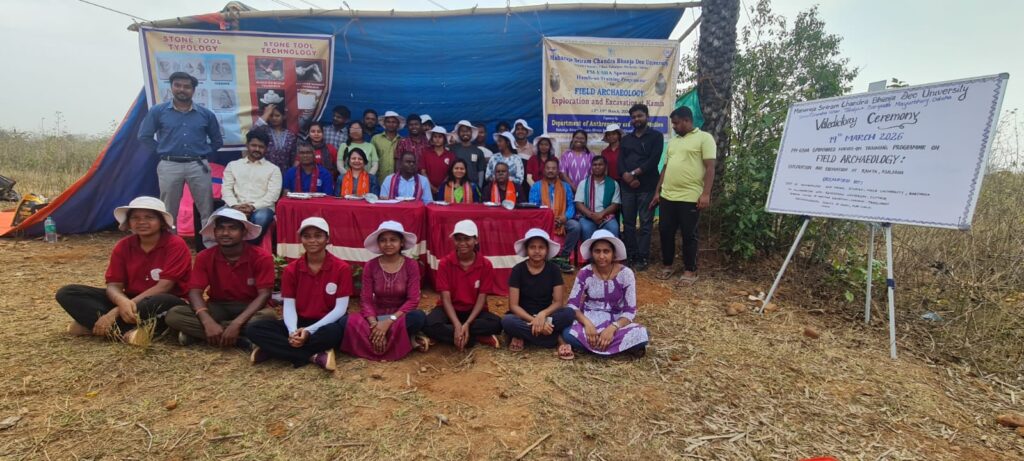
Baripada, ( କ ବ୍ୟୁ ) 19/03: An eight-day workshop on prehistoric culture, organized by the Department of Anthropology and Tribal Studies of Maharaja Sriram Chandra Bhanja Deo University with the support of the Pradhan Mantri Uchchatar Shiksha Abhiyan (PM-USHA), was successfully concluded today at Kuliana.
The workshop was conducted in collaboration with Ravenshaw University, Sharma Centre for Heritage Education, and the Archaeological Survey of India (ASI), Puri Circle.
The valedictory session was attended by several distinguished personalities, including former Chairman of the National Monuments Authority and former Vice-Chancellor of the university, Professor Kishor Kumar Basa; scientist Dr. Anjali Trivedi from the Birbal Sahni Institute of Palaeosciences; Deputy Director of the Culture Department, Government of Odisha, Dr. Debajani Bhuyan; Vice-Chancellor Professor Pramoda Kumar Satpathy; PM-USHA Nodal Officer Professor Indrajit Naik; Associate Professor Dr. Basanta Kumar Mohanta; and Dr. Bhubaneswar Sabar.
Students, researchers, and faculty members from the Departments of Anthropology and Tribal Studies and History of the university, as well as from Maharaja Purna Chandra Autonomous College, Ravenshaw University, and Gangadhar University, actively participated in the workshop.
This eight-day workshop focused on the rediscovery and revival of prehistoric cultural remains hidden in the Kuliana region of Mayurbhanj district.
During the workshop, Professor Shanti Pappu of Sharma centre of heritage studies, expressed that there are notable similarities between the prehistoric culture of Tamil Nadu and that of Kuliana.
According to archaeobotanist Dr. Anjali Trivedi, soil samples have been collected from the Kuliana area for laboratory analysis in order to obtain evidence of ancient plant remains.
Geologist Professor Srirup Goswami of Utkal University stated that there is a strong possibility of the existence of an ancient, extinct river or water source in the Kuliana region.
To determine the chronological framework of prehistoric culture and to obtain scientific evidence related to vegetation, environment, and ecological conditions, various samples have been collected from the archaeological excavation site at Kamta. These samples are planned to be sent to different scientific institutions across India for detailed analysis.
Experts, including former Chairman of the National Monuments Authority Professor Kishor Kumar Basa, archaeologist Dr. Basanta Kumar Mohanta of Maharaja Sriram Chandra Bhanja Deo University, and local researcher Manu Naik, believe that once the analysis of these prehistoric findings is completed, the Kuliana region has the potential to create a new chapter in history not only for India but also at the global level.
It is noteworthy that in 1948, Nirmal Bose and Dharani Sen of Calcutta University first conducted Stone Age excavations at Kuliana, establishing the region as a significant site in the archaeological history of Mayurbhanj and Odisha.
Earlier discoveries, including fossils and stone tools, helped reveal the prehistoric significance of the area. Findings from various locations in Mayurbhanj—particularly around Similipal, Kuliana, and the Budhabalanga river basin—indicate the presence of Lower, Middle, and Upper Palaeolithic cultures, as well as Mesolithic and Neolithic phases, according to archaeologists.
The estimated age of these remains is around 250,000 years, clearly indicating a long and continuous history of human habitation in the region.
In ancient times, areas such as Similipal, Kuliana, and the river basins of Budhabalanga and Subarnarekha were highly suitable for prehistoric human settlement. These regions provided abundant water resources, dense forests, huntable animals, and easily available raw materials like quartzite and quartz for making stone tools.
ଦୀନବନ୍ଧୁ ବାରିକ (ମୟୂରଭଞ୍ଜ ଜିଲ୍ଲା ପ୍ରତିନିଧି)